Biophysical and Computational Chemistry
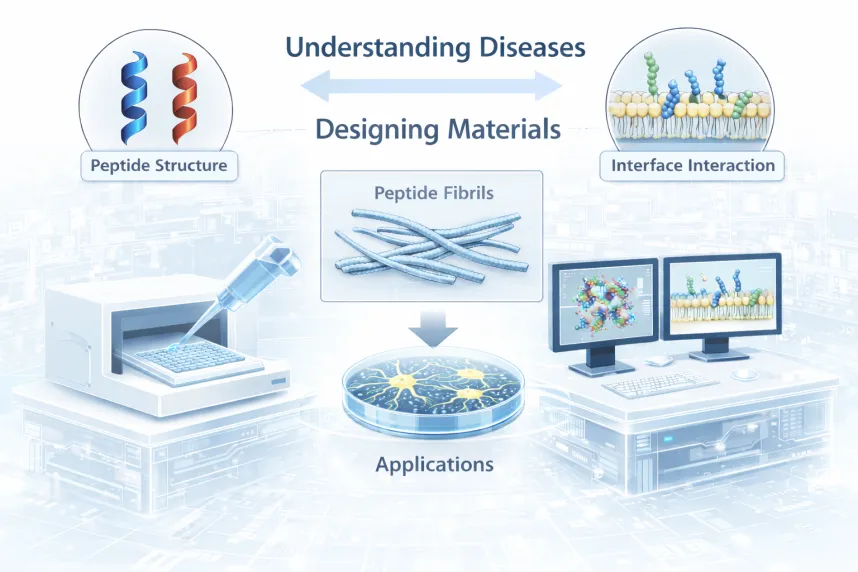

We investigate how peptide sequences encode self-assembly pathways at biological and synthetic interfaces, connecting molecular mechanisms to functional biomaterial design. By integrating biophysical experiments with molecular dynamics simulations, we establish mechanistic principles governing amyloid(-like) fibril formation, membrane activity, and nano-interface interactions.
- Interface-Controlled Peptide Self-Assembly: We study how biological and synthetic interfaces, including nanoparticles, inorganic surfaces, and soft matter systems, direct and modulate peptide self-assembly pathways. Using spectroscopy, surface-sensitive techniques including QCM-D, and molecular dynamics simulations, we investigate how interfacial properties control peptide adsorption, corona formation, and aggregation pathways relevant to neurodegenerative diseases.
- Sequence-Guided Design of Functional Peptide Fibrils: We decode how peptide sequence encodes fibril structure, polymorphism, and function. Building on this mechanistic understanding, we engineer functional bionanomaterials, including peptide fibrils and hybrid systems combining peptides with nucleic acids, for applications in catalysis, neural regeneration, and modulation of cell-material interactions.
- Membrane Activity of Self-Assembling and Antimicrobial Peptides: We investigate how self-assembling and antimicrobial peptides interact with lipid membranes. Using model membrane systems, liposomes, QCM-D, fluorescence spectroscopy, and molecular dynamics simulations, we explore how membrane composition, lipid oxidation, and peptide self-assembly govern membrane activity and antimicrobial selectivity.
- Research Contributions: Torsten John has established molecular-scale models explaining how interfaces influence peptide self-assembly, a key process in understanding neurodegenerative diseases, antimicrobial activity, and biomaterial function. His research, conducted at the Leibniz Institute of Surface Engineering, Monash University, MIT, and the Max Planck Institute for Polymer Research, has resulted in 28 peer-reviewed publications (790 citations, h-index 16, March 2026) in journals including Nature Chemistry, Angewandte Chemie, Chemical Science, and Advanced Functional Materials.
- Awards and Recognition: Torsten John has received several prestigious awards and fellowships, including recognition as Top 10 Young Scientist in Germany (academics.de Nachwuchspreis, 2024), the Feodor Lynen Fellowship from the Alexander von Humboldt Foundation (2021-2024), finalist for the Leibniz Dissertation Award (2021), finalist for the European Young Chemist Award (EuChemS, 2018), and inclusion in IUPAC's Periodic Table of Younger Chemists (2018). He was selected as a Young Scientist for the 70th and 71st Lindau Nobel Laureate Meetings (2020-2022) and as CAS SciFinder Future Leader (2017). He also received the Early Career Researcher Award from the Royal Australian Chemical Institute (2016).
The Biomolecular Systems and Design Lab is led by Prof. Dr. Torsten John and currently comprises one doctoral researcher, one technical assistant, and undergraduate thesis students. The lab is equipped with spectroscopic and surface-sensitive instrumentation including QCM-D, fluorescence spectroscopy, DLS, and UV-vis spectroscopy, alongside computational resources for molecular dynamics simulations.
Lahu, A.; Wu, S.; Schuler, M.; Mazzotta, F.; Ramadani, A.; Koca, E.; Lieberwirth, I.; Landfester, K.; John, T.; Ng, D. Y. W.; Weil, T. Co-Assemblies Regulate the Catalytic Activity of Peptide Fibrils. Angew. Chem. Int. Ed. 2026, 65, e11165.
DOI: https://doi.org/10.1002/anie.202511165
Alleva, N.; Zhang, J.; Ng, D. Y. W.; Weil, T.; John, T. Functionalizing Nucleic Acids: Synthesis and Purification Strategies for Bioconjugates as Biomaterials. Small 2026, 22, e10863.
DOI: https://doi.org/10.1002/smll.202510863
Tsai, Y. L.; Cavallo, P.; Lu, Q.; Yu, J.; Ender, C. P.; Link, J.; Amann-Winkel, K.; Endres, K.; Synatschke, C. V.; John, T. Design of the Hydrophobic Core of Self-Assembling Peptide Fibrils for Enhanced Neural Regeneration. Small Sci. 2025, 2500224.
DOI: https://doi.org/10.1002/smsc.202500224
Hayn, M.; John, T.; Bandak, J.; Rauch‐Wirth, L.; Abel, B.; Münch, J. Hybrid Materials From Peptide Nanofibrils and Magnetic Beads to Concentrate and Isolate Virus Particles. Adv. Funct. Mater. 2024, 34 (27), 2316260.
DOI: https://doi.org/10.1002/adfm.202316260
John, T.; Rampioni, A.; Poger, D.; Mark, A. E. Molecular Insights into the Dynamics of Amyloid Fibril Growth: Elongation and Lateral Assembly of GNNQQNY Protofibrils. ACS Chem. Neurosci. 2024. 15 (4), 716–723.
DOI: https://doi.org/10.1021/acschemneuro.3c00754
John, T.; Piantavigna, S.; Dealey, T. J. A.; Abel, B.; Risselada, H. J.; Martin, L. L. Lipid Oxidation Controls Peptide Self-Assembly near Membranes through a Surface Attraction Mechanism. Chem. Sci. 2023, 14 (14), 3730–3741.
DOI: https://doi.org/10.1039/D3SC00159H
John, T.; Gladytz, A.; Kubeil, C.; Martin, L. L.; Risselada, H. J.; Abel, B. Impact of Nanoparticles on Amyloid Peptide and Protein Aggregation: A Review with a Focus on Gold Nanoparticles. Nanoscale 2018, 10 (45), 20894–20913.
DOI: https://doi.org/10.1039/C8NR04506B
For a full publication list, see johnlab.de/publication and Google Scholar.