Young minds, maximum perspective: Constructor University hosts second Jugend Forscht regional science competition
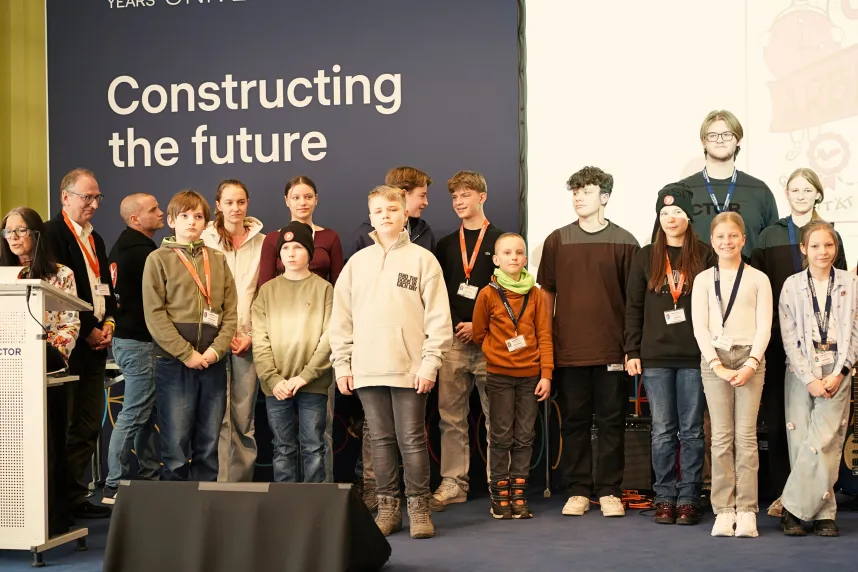
Rainwater filtration systems, space robots and a müsli assembly station. These were just a few of the science projects on display at the second annual Jugend Forscht regional science competition, held February 19 at Constructor University. Hosted in partnership with KUKA Assembly & Test GmbH and Jugend Forscht, the event brought more than 100 young scientists together from schools throughout Bremen Nord to present and honor the region’s most innovative science projects under the theme "Maximum Perspective.” Prizes were awarded to the best projects across seven categories and two age groups (Jugend Forscht and Jugend Forscht Junior), giving winners the opportunity to advance to state-level competition.
"The competition is an excellent tool for fostering talent, which is why we are proud to support Jugend forscht," said Renate Raschen, Competitions Officer at the Senator for Children and Education who was in attendance. "A strong network has developed here in Bremen-North over the past two years in close cooperation with Constructor University and KUKA. It’s so important for our schools to know that we have reliable partners who are willing to stand alongside the youth who have dedicated themselves to presenting their ideas here as young researchers."
big ideas for a changing world
The event featured an exhibition-style fair in Constructor University’s International Conference Center, where 49 participating teams showcased their projects and presented research findings with elaborate booths and displays. This year’s entries demonstrated curiosity, creativity and scientific rigor while tackling real-world challenges across seven categories: Working World, Biology, Chemistry, Geo and Space Sciences, Mathematics/Computer Science, and Technology. Gymnasium Vegesack school band "Die Bergboys" also opened the festivities with a spirited musical performance to the more than 300 people in attendance.
Among the standout projects, 10-year-old Talea Karachous from Grundschule Borchshöhe took top prize for Jugend Forscht Junior in the Chemistry category, for her investigation into whether different food colorings affects food taste, demonstrating through blindfolded tests that mashed potatoes, for example, taste different depending on the food coloring added. Meanwhile in the Technology category, 13-year-old Raphael Höhn from Oberschule In den Sandwehen won first prize for "PhoBi," an app he designed to monitor and control microalgae growth in production facilities.
The environment, sustainability and technology were popular themes this year, with numerous projects exploring water purification, resource conservation and waste reduction, whether here on earth or beyond. Eva Cicirello and Ina Manthei’s "KIVA” – a WALL-E-esque search-and-clean-up robot designed for space stations – earned second place in the Mathematics/Computer Science category. Another project from Thalia Baumgart, Fynn Zibke and Mattis Mersmann explored efficient water recycling systems for Mars.
Building community through science
For Gabriele Breuer, Regional Competition Director for Bremen Nord, Jugend Forscht, the event represented far more than a science fair, but rather an investment in the region's future and a powerful counterbalance to the feelings of marginalization that can affect young people in disadvantaged communities around Bremen Nord.
"Inspiring young people about science and technology is very important to me because we always need new ideas to keep our economy competitive and efficient," said Breuer. "That's why we need to start early with children, bringing them into contact with Jugend Forscht, so that natural curiosity doesn't get lost. Especially in communities like Bremen Nord, where people often feel overlooked or left behind, competitions like Jugend Forscht are particularly important. They reminds us time and again that we don't have to hide. I'm always amazed by the things children and young people think about and how they see the world. They want to make a difference and create change,” she said.
Building on the success of last year's inaugural event, this year's competition was once again co-hosted by presenting partners Constructor University and KUKA Assembly & Test GmbH. Jugend forscht is the largest public-private partnership of its kind in Germany, comprising around 250 partners, mostly from the business community. Constructor University and KUKA provided the resources to organize and host the competition for the Bremen Nord region, working with other community stakeholders to coordinate prizes and other materials for the event. Winners received cash prizes ranging from €45 to €75, along with special awards like scientific magazine subscriptions, DLR_School_Lab Club memberships, and recognition from the German Federal Ministry and other sponsors.
"In just its second year, the competition is already showing how powerful these encounters can be," said René Wells, Public Engagement Project Manager at Constructor University. "What we are building is a bridge—from the curiosity of school students to the experience of professional researchers. When students present their ideas, meet scientists, and experience a real research environment, knowledge begins to flow in both directions.”
The partnership reflects Constructor University's broader commitment to community engagement, regional development and promoting the sciences and higher learning in its home community. “By connecting schools, universities, and the wider scientific community, events like this strengthen the relationship between science and society,” added Wells. “These students are not just participants—they are the researchers, innovators, and problem-solvers who will help shape the future we are constructing together."
Winners from the regional competition will advance to represent Bremen Nord at the state-level Jugend Forscht competition, carrying forward the spirit of curiosity, innovation, and "maximum perspective" that defined this year's event.
Receive all updates straight to your inbox.